Amalfi Packing List: What to Pack for Stairs, Boats, and Coastal Weather
A practical Amalfi packing list: broken-in walking shoes for steep stairways, breathable summer layers, a church cover-up, rain gear, and boat-day extras.
On this page
Amalfi weather month by month
Typical conditions from 30 years of daily weather data — use it to see how much to pack for the month you are travelling.
| Month | High / low | Days with rain | Afternoon humidity | Daylight |
|---|---|---|---|---|
| January | 12° / 8°C (54° / 47°F) | 4 in 10 days | 61% | 9.4 h |
| February | 13° / 8°C (55° / 46°F) | 4 in 10 days | 58% | 10.4 h |
| March | 15° / 10°C (58° / 49°F) | 3 in 10 days | 59% | 11.7 h |
| April | 17° / 12°C (63° / 53°F) | 4 in 10 days | 60% | 13.1 h |
| May | 21° / 15°C (70° / 60°F) | 3 in 10 days | 60% | 14.3 h |
| June | 25° / 19°C (77° / 67°F) | 2 in 10 days | 60% | 14.9 h |
| July | 28° / 22°C (82° / 71°F) | 1 in 10 days | 58% | 14.6 h |
| August | 29° / 23°C (83° / 73°F) | 1 in 10 days | 57% | 13.6 h |
| September | 25° / 20°C (77° / 67°F) | 3 in 10 days | 58% | 12.3 h |
| October | 21° / 17°C (70° / 62°F) | 3 in 10 days | 61% | 10.9 h |
| November | 17° / 13°C (63° / 55°F) | 5 in 10 days | 62% | 9.7 h |
| December | 14° / 10°C (56° / 49°F) | 4 in 10 days | 61% | 9.1 h |
Travelling on specific dates? Use our What to Wear Planner for the weather, outfits and a packing list for your exact days in Amalfi.
Averages for 1991-2020, modelled from Copernicus ERA5-Land and ERA5 reanalysis via Open-Meteo open data (CC BY 4.0), adjusted to Amalfi's elevation. Modelled afternoon highs can read 1–2°C below airport weather-station records.
Amalfi compresses your packing decisions into a small compass. The town climbs a ravine above the Tyrrhenian Sea, so the same outfit has to work on steep stairways, in a church, and on a boat without a trip back to your room. That is why footwear and a light cover-up matter more here than in a flatter city.
You will walk on stone steps and uneven paving more than you expect, and coastal humidity changes how clothing feels by afternoon. The practical response is breathable fabrics, shoes you have already broken in, and one or two layers you can add or remove quickly.
Climate notes in this article describe historical seasonal tendencies, not a forecast for your dates. Check a reliable forecast for Amalfi in the days before you leave and adjust the capsule rather than packing for every scenario.
Why Amalfi Packs Differently from Rome or Florence
In Rome or Florence you can plan a day around museums, cafés, and relatively flat walking. Amalfi's historic center is vertical: streets become stairways, and a short walk to dinner may climb several flights of stone steps. An outfit that looks fine standing still can feel wrong after twenty minutes of climbing.
The other difference is the daily swing between environments. You might start the morning walking through town, spend midday on the water or at a beach, then visit the Duomo before dinner. A single capsule that handles all three keeps your bag small and your day flexible.
Because Amalfi is compact, overpacking is a real burden. You will carry your bag up steps and along narrow lanes, so a lighter suitcase is a comfort decision rather than a style one. Aim for a capsule that covers a week with a mid-trip wash if needed.
Start with the Terrain: Stairs, Slopes, and Cobblestones
Footwear is the highest-stakes choice. Amalfi's stairways and sloped lanes put constant stress on your feet and ankles, and a shoe with poor grip turns wet stone into a hazard. Prioritize a sole with real traction, a secure fit, and cushioning you have already tested on a long walk; a general Italy packing list makes the same point about cobblestones and steps, so treat shoes as gear rather than an afterthought.
This is where most packing mistakes happen: brand-new shoes that felt fine in a shop become painful after a day of steps. Break in your main walking shoes for several weeks before departure, and bring only pairs you have worn for at least a few hours at a time. For more detailed footwear trade-offs on this terrain, this guide to Amalfi stairways and vertical village walking shoes covers the options.
Cobblestones and polished stone steps punish thin, hard soles and loose straps. A shoe that slips off your heel on a flat sidewalk will slip more on a descent, so avoid anything you have to grip with your toes. One reliable walking shoe plus one lighter option is usually enough for a week.
What to Wear in Amalfi in Summer: Heat, Humidity, and Sun
Summer in Amalfi tends to be hot and humid, and the sun is strong along the Mediterranean. Breathable linen and cotton blouses, light trousers, and loose dresses handle the heat far better than heavy synthetic fabrics that trap moisture. Light colors also help, though any fabric that dries quickly will work.
Sun protection belongs in your day bag, not your suitcase. Sunglasses, a hat, and a light scarf or pashmina cover you from glare and wind and double as shoulder cover when you step into a church. A reusable water bottle is also worth the space, since refilling is easy in Italian towns.
A swimsuit is not just for the beach. It makes beach-to-village transitions simple: swim, change under a cover-up or in a beach facility, and keep walking. Pack one that dries quickly so it does not weigh down your bag the next morning.
Shoulder-Season Packing: Rain, Wind, and Cooler Evenings
Autumn brings a shift in what the same capsule needs. Historical averages for the Amalfi Coast in October show highs around 22°C (about 72°F) and lows near 11°C (about 52°F), with October and November among Italy's rainier months. Those are seasonal tendencies, not a promise for your trip, so verify the forecast before you finalize layers.
Rain changes the footwear and outerwear decisions more than anything else. A waterproof layer or trench and a pair of waterproof boots handle wet stone steps and sudden showers better than a fashion jacket and suede shoes. If you are traveling later in the season, this guide to what to wear in Amalfi in November walks through the colder, wetter version of the same capsule.
Evenings near the sea can feel noticeably cooler than the afternoon, especially when wind picks up along the coast. A cardigan, light blazer, or compact jacket gives you a layer to add at dinner without changing your whole outfit. A scarf is a small item that earns its place by blocking wind and adding warmth on a boat or waterfront walk.
The Layering Capsule: Tops, Bottoms, and One or Two Outer Layers
Build the capsule around a small number of pieces that all work together. Three or four tops, two pairs of trousers, one or two dresses, and one or two outer layers cover most trips if you choose colors that mix easily. This is not a minimalism contest; it is about every item earning space in a bag you will carry up stairs.
Choose fabrics that layer without bulk. Linen and cotton for warm days, a fine knit or cardigan for evenings, and a light waterproof shell for rain give you temperature control without a second wardrobe. Trousers that cuff work as shorts on a hot afternoon.
One cover-up does double duty across the capsule. A light shawl or pashmina works as shoulder cover in churches, a wrap on a breezy boat, and a layer over a dress at dinner. Packing one rather than three keeps the bag light and the choices simple.
Footwear Trade-Offs: Walking Shoes vs. Sandals vs. Beach Shoes
Supportive sandals can work for town walking if the straps are secure and the sole has grip, but they are a compromise on long stair descents. Walking shoes offer more stability and cushioning, while beach shoes or water sandals handle rocky entries and wet surfaces. The right mix depends on how much time you plan to spend on boats and beaches versus in town.
A practical split for a week is one broken-in walking shoe, one lighter sandal for warm evenings or easy days, and one pair of water-friendly shoes only if you expect beach or boat time. That is three pairs at most, which is already generous for a carry-on. If you can only bring two, keep the walking shoe and the sandal.
Leave the flip-flops for the pool deck. They offer no grip on wet stone and no support for steps, and they are the single most common footwear regret on this kind of terrain. A secure sandal does everything a flip-flop does and more.
Modest Cover-Ups for Churches and the Duomo
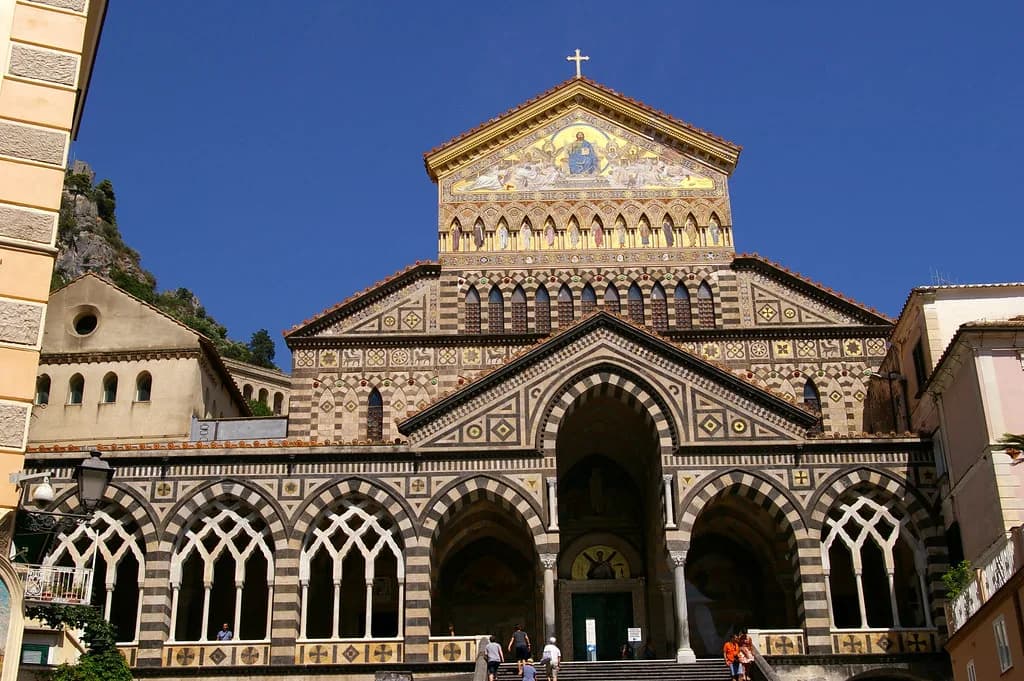
Many Italian churches, including the Amalfi Duomo, expect visitors to cover shoulders and knees as a matter of respect. This is a general expectation, not a uniform rule you can verify for every doorway, so treat a light cover-up as the safe default. A shawl, pashmina, or light scarf in your day bag solves it instantly.
The cover-up does not need to be a separate outfit. A wide scarf over a sleeveless dress, or a light cardigan over a tank top, meets the covered-shoulders and covered-knees guidance without changing your plans. Keep it in your bag rather than your suitcase so it is always with you.
If you are unsure whether a specific site has additional requirements, ask at the entrance or check the site's own information before you go. Avoid relying on secondhand claims about entrance rules, and do not plan an outfit around a restriction you have not confirmed.
Beach-to-Village Transitions and Boat Days
The beach-to-village transition is the test of a good Amalfi capsule. You want to swim, dry off, and walk through town without returning to your room, which means a cover-up that works as clothing, a bag that keeps sand out of your essentials, and shoes that handle both sand and stone. A light dress over a swimsuit is the simplest version of this.
On a boat day, wind and spray matter more than heat. A scarf, a light jacket, and a bag that closes securely keep you comfortable when the boat picks up speed. Sunscreen and sunglasses are not optional on the water, where reflection intensifies exposure.
A quick-dry towel and a small dry bag are the two items that make water days noticeably easier. They take almost no space and prevent wet swimwear from soaking the rest of your bag. Leave the heavy beach towel at home and use a compact travel towel instead.
What to Leave Behind on an Amalfi Trip
Leave the shoes you have not broken in. This is the most important exclusion on the list, because a blister on day one shapes the rest of the trip. Also leave heavy denim, thick jackets, and anything that only works for one specific outfit.
Skip bulky beach gear such as large towels, full-size umbrellas, and multiple bags. A compact travel umbrella handles rain without the weight, and a single crossbody bag works for town, church, and boat. Excess luggage is a real cost when you are carrying it up steps.
Leave behind anything you are only packing because a checklist told you to. If you cannot name the day you will wear it, it probably stays home. That rule alone will cut your bag weight significantly.
A Compact Packing Example for a Short Trip
For a four- to five-day trip, start with three tops, two pairs of trousers or one trouser and one skirt, one dress, and one swimsuit. Add a cardigan, a light rain layer, and one shawl. That is enough for mixed days if you choose pieces that layer.
For footwear, bring one broken-in walking shoe and one supportive sandal, plus water shoes only if boats or beaches are central to your plans. Add sunglasses, a hat, sunscreen, a reusable water bottle, and a compact towel. This fits in a carry-on for most travelers, which makes stairways and transfers far easier.
If your trip runs longer, plan a mid-trip wash rather than doubling every item. A laundry stop is usually simpler than managing a heavy bag on Amalfi's steps. For a broader seasonal comparison, see how northern Italy packing differs in the Bergamo packing list, or the alpine conditions in a Bolzano packing list that have little in common with the coast.
Before You Go: Check the Forecast and Confirm Your Plans
In the last few days before departure, check the forecast for Amalfi and adjust your layers rather than rebuilding the whole capsule. If rain is likely, make sure your waterproof layer and shoes are packed. If a heat wave is expected, add an extra light top and plan around midday shade.
Confirm any plans that affect packing, such as boat trips, beach facilities, or sites you want to visit, directly with the operator or venue. Rules, schedules, and availability can change, and checking the source is faster than guessing. This is especially useful in the shoulder season, when services may be reduced.
Pack your bag the night before and walk a few flights of stairs with it if you can. That single test tells you more about whether you have overpacked than any checklist. If it feels heavy, remove one pair of shoes or one outfit before you leave.
Plan Your Visit
Amalfi rewards a small capsule built around two decisions: shoes that grip and support you on stairs, and layers that move with you from beach to church to dinner. Get those right and the rest of the list falls into place.
Choose breathable fabrics for summer, add a waterproof layer and warmer knit for the shoulder season, and keep one light cover-up in your day bag. Check the forecast before you leave and confirm any activity that affects what you carry.
Pack light, break in your shoes early, and leave the just-in-case items at home. A lighter bag makes every stairway, ferry, and narrow lane easier to enjoy.
More packing guides for Italy
- What to Pack for an Amalfi Shoulder-Season Beach and Village Day
- Packing for Amalfi Ferry and Coastal Boat Days
- What to Wear for Amalfi's Steep Stairways and Vertical Village Walking
- What to Wear in Amalfi in November: Rain-Ready Packing Guide
- Ravenna Packing List: What to Wear for Mosaics and Humid Weather
- Matera Packing List: What to Wear in the Sassi
Frequently Asked Questions
What shoes should I wear in Amalfi?
Choose a broken-in walking shoe with good grip and cushioning, since Amalfi's stairways and sloped lanes put constant stress on your feet. Supportive sandals can work for easier days if the straps are secure, and water shoes help on rocky beaches. Avoid brand-new shoes and flip-flops, which offer little traction on wet stone.
What should I wear to the Amalfi Duomo?
Cover your shoulders and knees as a general mark of respect in Italian churches. A light shawl, pashmina, or cardigan carried in your day bag handles this without requiring a separate outfit. If a specific site has additional requirements, check with the site directly before your visit.
Do I need a swimsuit for the Amalfi Coast?
A swimsuit is worth packing if you plan any beach or boat time, and it makes beach-to-village transitions simpler because you can swim and keep walking. Choose a quick-drying suit so it does not weigh down your bag. If your trip is entirely town-focused in cooler months, you can leave it at home.
What should I pack for Amalfi in October?
October is a transition month on the coast, so pack layers rather than a single-weather wardrobe. Historical averages suggest mild days and cooler evenings, with rain becoming more likely later in the season. Bring a waterproof layer, a warmer knit or jacket, and shoes with grip for wet steps.
Is Amalfi humid in summer?
Summer on the Amalfi Coast tends to be hot and humid, which is why breathable linen and cotton work better than heavy fabrics. Loose cuts and light colors help you stay comfortable while walking and climbing steps. A hat, sunglasses, and sunscreen are worth carrying for strong midday sun.
What should I not bring to the Amalfi Coast?
Leave heavy denim, thick jackets, bulky beach towels, and brand-new shoes at home. Amalfi's vertical layout means extra weight is felt on every stairway, and a shoe you have not broken in is the most common cause of discomfort. Pack a compact towel and a single crossbody bag instead of multiple bags.
How do I pack light for Amalfi stairs and ferry days?
Build a small capsule of tops, bottoms, one or two dresses, and one or two outer layers that all mix together. Limit yourself to one or two pairs of shoes, plus water shoes only if needed, and plan a mid-trip wash for longer stays. A lighter bag is easier to carry up steps and onto boats.
Sources
Free: The Ultimate Packing Cheat Sheet
A carry-on capsule wardrobe, the complete packing checklist, layering made simple, and what to wear by season — one printable page you'll use on every trip.
You might also like


Continue reading
More guides you'll find useful