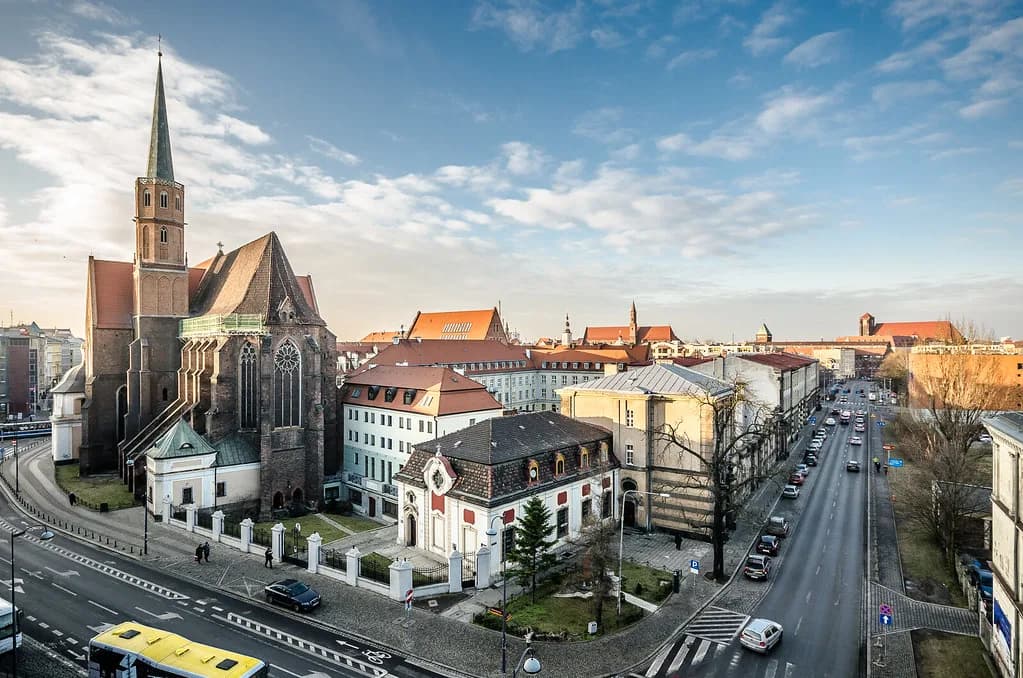
Wroclaw Packing List: Layers for Every Season
A Wroclaw packing list for every season: adaptable layers, weatherproof footwear for cobblestone streets, a light day bag, and a compact trip-length example.
On this page
Wroclaw weather month by month
Typical conditions from 30 years of daily weather data — use it to see how much to pack for the month you are travelling.
| Month | High / low | Days with rain | Days with snow | Afternoon humidity | Daylight |
|---|---|---|---|---|---|
| January | 2° / -3°C (36° / 27°F) | 4 in 10 days | 2 in 10 days | 68% | 8.2 h |
| February | 4° / -2°C (39° / 28°F) | 3 in 10 days | 2 in 10 days | 63% | 9.7 h |
| March | 8° / 0°C (47° / 33°F) | 4 in 10 days | 1 in 10 days | 57% | 11.5 h |
| April | 14° / 5°C (58° / 40°F) | 3 in 10 days | Rare | 51% | 13.6 h |
| May | 19° / 10°C (66° / 49°F) | 4 in 10 days | Rare | 52% | 15.3 h |
| June | 22° / 13°C (72° / 56°F) | 4 in 10 days | Rare | 53% | 16.3 h |
| July | 24° / 15°C (75° / 59°F) | 4 in 10 days | Rare | 53% | 15.9 h |
| August | 24° / 15°C (76° / 59°F) | 3 in 10 days | Rare | 52% | 14.4 h |
| September | 19° / 11°C (67° / 52°F) | 3 in 10 days | Rare | 57% | 12.4 h |
| October | 14° / 7°C (56° / 44°F) | 3 in 10 days | Rare | 63% | 10.4 h |
| November | 8° / 3°C (46° / 37°F) | 3 in 10 days | 1 in 10 days | 70% | 8.6 h |
| December | 3° / -1°C (38° / 30°F) | 3 in 10 days | 1 in 10 days | 71% | 7.7 h |
Travelling on specific dates? Use our What to Wear Planner for the weather, outfits and a packing list for your exact days in Wroclaw.
Averages for 1991-2020, modelled from Copernicus ERA5-Land and ERA5 reanalysis via Open-Meteo open data (CC BY 4.0), adjusted to Wroclaw's elevation. Modelled afternoon highs can read 1–2°C below airport weather-station records.
A Wroclaw packing list has less to do with dramatic weather than with constant transitions. A day that starts on cold stone pavement can move into a heated museum, a warm cafe, and then a windy walk along the Odra, so the bag has to flex. Layers handle that shift better than any single heavy garment.
This guide treats seasonal patterns as historical tendencies, not a forecast. It also separates editorial suggestions, such as packing a scarf for evening terraces, from anything an organiser or authority actually requires. Check the current forecast and any venue rules before you finalise the bag.
Start With the Season, Not the Suitcase
Poland sits in a continental climate zone, which in practice means warm summers, cold winters, and shoulder seasons where one day can behave like two. General Poland packing guidance frames layering as the core strategy because rain can arrive at any time of year and wind changes how a day feels. That logic applies directly to Wroclaw, even without pinning down month-by-month numbers.
The practical consequence is that your first decision is not how many outfits to bring but which outer layer matches your travel window. A warm waterproof shell earns its space in cold months, while a light folding waterproof jacket covers the rest of the year without adding bulk. Everything else, from base layers to socks, can then be scaled around that single choice.
Layering That Works in Wroclaw
Think in three functional layers: a base that manages sweat, a mid layer that traps warmth, and an outer layer that blocks wind and rain. This combination lets you strip down inside a heated museum and rebuild before stepping back onto a chilly street or a bridge. Bulky single-purpose pieces cannot make that adjustment, which is why they usually end up unworn.
Merino or synthetic base layers dry faster than cotton and take less space in the bag. A thin fleece or fine-knit sweater works as the mid layer for most of the year, with a heavier version reserved for deep winter. The outer layer should be roomy enough to fit over both without compressing the insulation.
Two accessories matter more than a wardrobe of alternatives: a scarf and a compact umbrella. The scarf adds warmth at the neck on breezy riverfront evenings and can double as a shoulder cover if you step into a church. A small folding umbrella lives in the day bag without weighing it down.
Cold-Season Layers: Warm, Waterproof, and Wind-Aware
From late autumn through early spring, the priority shifts to insulation that still lets you move. A warm waterproof coat or jacket is the single most important item, and it is worth wearing it on the plane to save luggage space. Underneath, a base layer plus a sweater gives you options when interiors are heated.
Thermal socks and proper cold-weather footwear matter as much as the coat. General Poland packing advice pairs quality thermal socks with boots or warm walking shoes for winter city days, because cold feet end an afternoon faster than cold hands do. A hat, gloves, and a scarf round out the kit without adding much weight.
If your trip runs into the tail of winter, February often keeps the cold but adds more daylight and occasional thaws. A dedicated month guide covers what to wear in Wroclaw in February with more granular layer and footwear choices for that window.
Warm and Shoulder-Season Packing
Once the risk of hard frost fades, the light folding waterproof jacket becomes the workhorse outer layer. It handles sudden showers, blocks wind on bridges, and packs into the day bag when the sun returns. Breathable tops underneath keep you comfortable when you move between warm interiors and cooler streets.
Spring shoulder season still rewards a mid layer, because mornings and evenings can feel several degrees cooler than midday. March is a classic example: brighter days arrive, but the wind and residual chill make a sweater and scarf useful. A month-specific view of what to wear in Wroclaw in March helps you calibrate those shoulder-season layers.
In warmer months, focus on breathable fabrics and sun protection rather than extra clothing. Lightweight trousers or a skirt, a couple of short-sleeved tops, and a hat cover most days. One long-sleeved layer and the folding jacket stay in the bag for evening temperature drops and unexpected rain.
Footwear for Cobblestones and River Paths
Footwear is where Wroclaw packing decisions have the biggest payoff. Historic centres and river-island paths often mean long stretches on uneven stone, so a dependable pair of comfortable walking shoes with real cushioning and decent grip beats fashion trainers. General Poland guidance consistently puts walking shoes ahead of extra outfit variety for city trips.
Think of footwear as a trade-off rather than a single answer. Cushioned trainers are comfortable on long days but dry slowly if they get soaked; waterproof leather or synthetic shoes handle wet cobbles better but can be warmer in summer. Choose based on the season and how much rain you are prepared to walk through.
Trams and buses add another consideration: quick on-and-off movement rewards shoes that are secure but easy to slip on. If you plan to explore Ostrów Tumski and the Odra islands on foot, a light day bag keeps water, a map, and a spare layer close without slowing you down. That combination of stable shoes and a compact bag covers most Wroclaw days.
What to Wear for Churches, University Areas, and Evening Terraces
There is no verified universal dress code for visitors to Wroclaw, and it would be misleading to present one. Many churches ask for quiet, respectful behaviour and may expect covered shoulders or knees, but specifics vary by building. Check the entrance notices or the parish website if you plan to visit during services.
As an editorial suggestion, a smart-casual outfit works well for university areas and evening terraces: clean trousers or a skirt, a simple top, and a light layer for the walk home. A scarf that can cover shoulders is a useful multi-tool if you enter a place of worship. This is a comfort and courtesy choice, not a rule that locals all follow.
For evenings near the river or on a terrace, add a slightly warmer layer than you think you need. Open areas along the Odra can feel noticeably cooler than sheltered streets, and the difference is easy to underestimate after a warm afternoon. A compact scarf or a light knit in the day bag solves that without a second outfit.
A Compact Trip-Length Packing Example
For a four- to five-day city break, base the bag on two pairs of trousers, three tops, one mid layer, one outer layer, and one pair of walking shoes. Add socks and underwear for the full trip, a sleep shirt, and a small toiletry kit. That set covers every combination you are likely to need without repeat laundry stops.
If you prefer to travel with cabin baggage only, wear the bulkiest items on travel days and pack the light folding jacket at the top of the bag. Laundry access in hotels or nearby services can extend the same kit for a longer stay. The goal is a bag you can carry up hotel stairs and onto a tram without rearranging your day.
What to Leave Behind
Leave duplicates first. A second pair of jeans, a third pair of shoes, and multiple heavy sweaters add weight without adding real flexibility. If you are unsure about an item, cut the copy rather than the weather layer that protects your walking day.
Skip bulky single-purpose gear such as thick ski-style jackets for a city trip, beach-level resort clothing, and anything that only works for one photo. A formal outfit is rarely necessary for Wroclaw restaurants and terraces, and Polish cities have shops if something small is missing. A lighter bag makes station stairs, trams, and hotel changes noticeably easier.
Before-Departure Weather Check
Seasonal tendencies are a planning tool, not a forecast. A week before departure, check a reliable weather service for Wroclaw and look at the daily high, low, wind, and precipitation chance. That snapshot tells you whether to add a warmer mid layer or swap boots for lighter shoes.
Also check the forecast for the days you will actually be walking, not just the day you land. If a cold front or rain spell is due mid-trip, pack the waterproof outer layer and thermal socks without hesitation. If the pattern looks mild and dry, the light folding jacket and breathable layers may be enough.
Pack So the Bag Supports the Walking Day
Wroclaw rewards a bag built around movement: one dependable pair of walking shoes, a layer system you can adjust, and a day bag light enough for trams, churches, and river paths. The city is best experienced on foot, and your packing choices either protect that or get in the way.
Use the seasonal sections as a starting point, then verify with a current forecast before you close the suitcase. Leave the duplicates behind, keep the weather layer, and let the itinerary decide what earns a place in the bag.
More packing guides for Poland
- What to Wear in Wroclaw for a River Island Walk
- What to Wear in Wroclaw in August: Packing Guide
- What to Wear in Wroclaw in December: A Warm Layering Guide
- What to Wear in Wroclaw in February: Late-Winter Packing
- What to Wear in Wroclaw in March: Layering for Early Spring
- What to Wear in Wroclaw in May: Layering for Mild Days
- What to Wear in Wroclaw in November: Late-Autumn Packing Guide
- What to Wear in Wroclaw in October: Packing Guide
- What to Wear in Wroclaw in September: Packing Guide
- Warsaw Packing List: What to Wear in Every Season
- Poznan Packing List: What to Wear and Pack in Every Season
Frequently Asked Questions
What shoes should I pack for cobblestone streets in Wroclaw?
Choose comfortable walking shoes with cushioning, grip, and enough support for several hours on uneven stone. Waterproof or water-resistant options help on wet days, but they can be warmer in summer. If you bring trainers, make sure they are broken in and have decent tread.
Do I need a waterproof jacket for Wroclaw outside winter?
A light folding waterproof jacket is a practical item for most of the year because rain can arrive at any time. It packs small, blocks wind, and works over a sweater or a t-shirt. In colder months, switch to a warm waterproof outer layer that can fit a mid layer underneath.
How should I dress for churches in Wroclaw?
There is no single verified dress code, but many churches ask for quiet, respectful behaviour and may expect covered shoulders or knees. Entrance notices or a parish website are the best source for a specific building. A scarf or light layer in your day bag gives you an easy way to cover up if needed.
What should I wear on a spring day in Wroclaw?
Start with a base layer and a sweater, add a light waterproof outer layer, and keep a scarf in the bag. Mornings and evenings can feel noticeably cooler than midday, so removable layers are more useful than a single heavy jacket. Closed shoes with grip work better than sandals on stone streets.
How many days in Wroclaw is enough?
A short city break of three to four days covers the main historic areas, Ostrów Tumski, and a few museums at a comfortable pace. Five days gives you room for day trips or slower exploration. Packing for either length works with the same layered kit and one pair of walking shoes.
Sources
Free: The Ultimate Packing Cheat Sheet
A carry-on capsule wardrobe, the complete packing checklist, layering made simple, and what to wear by season — one printable page you'll use on every trip.
You might also like


Continue reading
More guides you'll find useful