
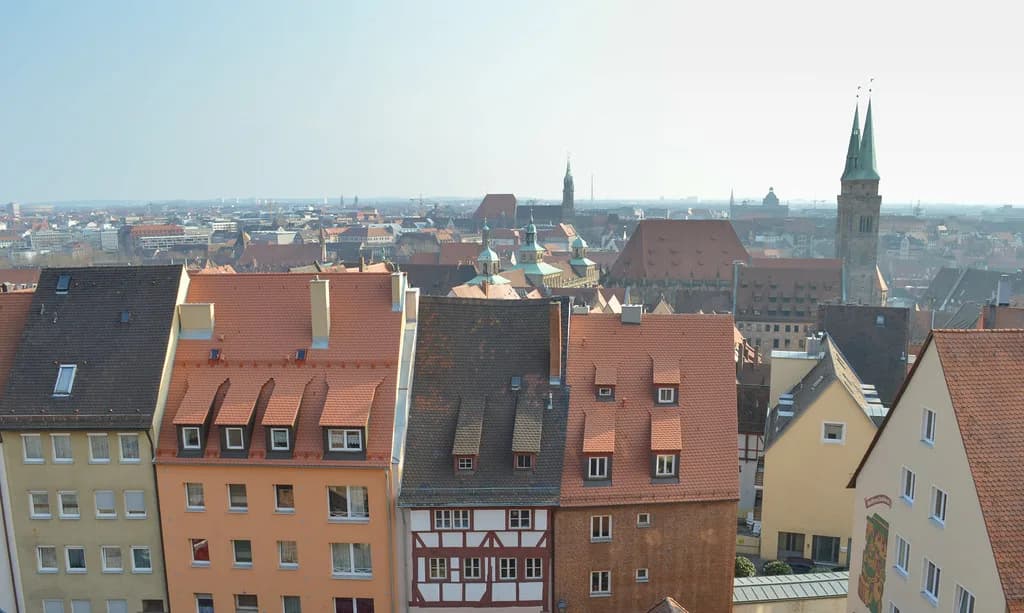
What to Wear in Nuremberg in December: A Packing Guide
Packing for Nuremberg in December means dressing for long, cold hours at the Christmas market. Here are the layers, footwear, and extras that work.
On this page
Nuremberg in December: the weather in numbers
Typical December conditions from 30 years of daily weather data, split into early, mid and late month so you can match them to your travel dates.
| Dates | Early Dec (1–10) | Mid Dec (11–20) | Late Dec (21–31) |
|---|---|---|---|
| Afternoon high | 5°C (40°F) | 4°C (39°F) | 4°C (38°F) |
| Night-time low | 0°C (32°F) | -1°C (31°F) | -1°C (30°F) |
| Feels like (afternoon) | 0°C (32°F) | -1°C (31°F) | -1°C (30°F) |
| Range of afternoon highs | 0–9°C | 0–9°C | -1–9°C |
| Days with rain | 4 in 10 days | 5 in 10 days | 5 in 10 days |
| Days with snow | 1 in 10 days | 2 in 10 days | 2 in 10 days |
| Afternoon humidity | 72% | 72% | 71% |
| Average wind | 12 km/h | 12 km/h | 13 km/h |
| Daylight | 8.1 h | 8 h | 8 h |
What this means for your suitcase
- Cold days: a winter coat, hat, gloves and a thermal base layer.
- Snow falls on about 2 in 10 days — waterproof boots with good grip.
- Rain on about 4 in 10 days — a waterproof jacket and water-resistant shoes.
- Day-to-day swings: afternoon highs range from about 0°C to 9°C, so pack for both.
Travelling on specific dates? Use our What to Wear Planner for the weather, outfits and a packing list for your exact days in Nuremberg.
Averages for 1991-2020, modelled from Copernicus ERA5-Land and ERA5 reanalysis via Open-Meteo open data (CC BY 4.0), adjusted to Nuremberg's elevation. Modelled afternoon highs can read 1–2°C below airport weather-station records.
December in Nuremberg is less about surviving a walk and more about surviving a stand. The Christkindlesmarkt keeps you outdoors in near-freezing temperatures for hours at a time, often on foot, so what you wear matters more than how much you bring.
That changes the packing logic. Athletic warmth built for movement is less useful than insulation you can keep on while holding a mug of Glühwein, and one versatile coat beats three heavy options when you are moving between stalls, shops, and transit on foot.
How Cold December in Nuremberg Tends to Feel
December and January are typically Germany's coldest months, with temperatures generally hovering around freezing. This is a historical seasonal tendency rather than a forecast for your dates, and conditions vary by year and location.
Precipitation in a German winter outside the Alpine regions often falls as rain rather than snow, so plan for damp cold as much as for snow. That distinction matters for fabric choice: wet cotton against your skin is a worse problem than a gray sky.
Because December conditions in Nuremberg vary year to year, check the forecast in the days before departure for the actual range during your trip. Then adjust the layers you pack rather than replacing the whole system.
The Three-Layer System That Does the Work
Start with a moisture-wicking base layer, add a fleece or sweater as a warmth layer, and finish with a weather-resistant outer coat that cuts wind. The outer layer is what makes near-freezing air feel manageable rather than raw.
The value of three layers is adjustment, not just warmth. You will move between cold streets and warm interiors, so being able to unzip the shell and shed a mid-layer beats one heavy jacket you either keep on and overheat in or take off and freeze without.
Pack base layers that dry quickly and avoid cotton next to your skin, since damp cotton stays cold. That single fabric decision does more for comfort than any extra sweater packed as backup.
Why Layering Beats One Heavy Coat
A single bulky coat gives you two states: on and off. Layering gives you five or six, which is what you need when you are stepping into a shop, sitting down for a meal, and then heading back out into the cold.
A practical approach is to pack a four-day clothing set and wear most pieces twice, with socks and base layers as the exception. That set covers roughly a week of outfits without a second suitcase, and a compact trip example later in this guide spells out the pieces.
If you are weighing whether the cold will be more like November or more like deep winter, compare your dates with what to wear in Nuremberg in November to see how the layering shifts month to month.
Footwear and Socks for Cobblestones
Choose one broken-in, weather-resistant walking shoe or boot built for long days on cobblestones, and wear it in before you leave. Grip-friendly soles are a practical suggestion, not a rule, but the old town's largely pedestrian lanes and walkable layout mean you will be on your feet for hours.
Warm wool socks matter more than most people expect, and at least one extra pair belongs in your bag. If your feet get cold and damp, the rest of you will be cold no matter how good your coat is.
One versatile pair beats two. Because Nuremberg's trams, buses, and U-Bahn let you move around without a car, you rarely need a second set of shoes, and a spare pair just adds bulk to your luggage.
Head, Hands, and Neck
A warm hat, scarf, and gloves are the difference between comfortable and miserable when you are standing still, which is exactly what browsing market stalls involves. Treat them as the highest-value small items in your bag rather than afterthoughts.
Glove liners that let you manage food, drinks, or a phone are a convenience suggestion, not a verified requirement. If you plan to eat and drink at the market while keeping your hands warm, a liner under a warmer glove is an easy option.
A scarf earns its space by sealing the gap between coat collar and neck, where cold air gets in when you stand still. Choose one that wraps rather than drapes so it stays put while you eat.
Christmas Market Packing Decisions
Standing still outdoors is colder than walking, so add insulation you can keep on while eating or drinking rather than layers you must remove to use your hands. That means prioritizing a warm mid-layer and a hat over a coat you open the moment you sit down.
Keep valuables and transit tickets somewhere you can reach without taking off gloves. A zipped inner pocket or a small crossbody bag under your coat solves this and also keeps your hands free for warm drinks.
Plan to warm up indoors between market rounds, because a heated shop, café, or restaurant break resets your body temperature faster than another layer does. Build those stops into your day so you are not trying to out-dress the cold for six straight hours.
Getting Around Without Overpacking
Nuremberg's trams, buses, and U-Bahn make a car unnecessary, which changes what you pack: no need for a second heavy coat kept in a vehicle, and no need for multiple shoe options. One coat and one proven pair of shoes cover the whole trip.
Carry a compact day bag for layers you shed indoors. A bag that folds into your luggage is better than a rigid one, because it only needs to hold a scarf, hat, and gloves while you are inside.
A Compact Packing Example for Four to Six Days
For a four-to-six day December trip, pack base layers, two sweaters, two pairs of weather-resistant pants, one weather-resistant coat, several pairs of wool socks, one broken-in walking shoe or boot, a hat, a scarf, and gloves. Wearing most pieces twice stretches that set to roughly a week of outfits, with socks and base layers as the items you do not re-wear.
Keep colors neutral and interchangeable so every top works with every bottom. That is the mechanism that makes a small set look like more than it is, and it also means a single stray stain does not ruin an outfit.
If your trip includes walking beyond the old town, the same logic carries over from what to wear for walking in Nuremberg old town, where footwear and layer adjustments follow the same rules.
What to Leave Behind
Leave bulky single-purpose gear you will not use, multiple pairs of heavy boots, and dressy shoes that will not handle cobblestones. Cotton layers that stay damp also belong at home, along with anything you cannot layer under or over something else.
The test is simple: if an item cannot be worn in more than one configuration, it has to justify its weight. In a cold-weather city where you are on foot, a single coat and one reliable pair of shoes do more than a bigger suitcase.
Before You Go
Check the Nuremberg forecast in the days before departure rather than relying on seasonal averages. Then confirm your layers and footwear against the surfaces you will actually meet, whether that is damp pavement or frost.
Pack socks and gloves as spares, because those are the items that get damp first and the ones you will want to swap. A dry pair of socks in your day bag is cheap insurance for a long market evening.
Dressing Practically, Not Costume-Like
Practical, weather-resistant clothing is a common approach to German winter dressing, and that works in your favor as a visitor. Neutral colors that mix and match, outer fabrics that shed wind and damp, and shoes meant for walking cover most December days without any special effort.
These are suggestions rather than rules, and there is no dress code to meet. If you want a warmer-weather comparison to underline how much of this is climate-driven, what to Wear Barcelona in December shows how the same layering logic changes in a milder city.
Plan Your Visit
The deciding factors for Nuremberg in December are insulation, dry feet, and hands that still work while you eat and drink. Pack for standing still, layer for the frequent indoor breaks, and let one good coat and one broken-in pair of shoes carry the trip.
Check the forecast before you go, pack spare socks and gloves, and leave the items that only work in one configuration at home. That combination handles a cold, market-heavy December without an oversized suitcase.
More packing guides for Nuremberg
Frequently Asked Questions
How cold is Nuremberg in December?
December and January are typically Germany's coldest months, with temperatures generally hovering around freezing. That is a historical seasonal tendency rather than a forecast, and conditions vary by year. Check the Nuremberg forecast in the days before departure for the actual conditions during your trip.
How do people dress in Germany in December?
Practical, layered, and weather-resistant is a common approach to German winter dressing. A base layer, a warm mid-layer such as a fleece or sweater, and a wind- and weather-resistant outer coat, paired with sturdy walking shoes and warm socks, cover most situations. This describes a common approach rather than a uniform, and visitors can follow the same logic without matching any particular style.
Is the three-layer approach useful for winter packing in Nuremberg?
A moisture-wicking base layer, a warm mid-layer, and a weather-resistant outer coat is a reasonable starting point for Nuremberg in December. Beyond that, a compact set of clothing re-worn twice can cover roughly a week, with socks and base layers as the items you pack in greater quantity. The goal is adjustability rather than a fixed number of garments.
Do you need snow boots for Nuremberg in December?
One broken-in, weather-resistant walking shoe or boot with grip-friendly soles covers most December conditions on cobblestones. Precipitation in German winters outside the Alpine regions often falls as rain rather than snow, so a waterproof walking shoe may serve you as well as a dedicated snow boot. Check the forecast before departure and decide based on the surfaces you expect.
What should women pack for Nuremberg in December?
The same three-layer system works regardless of style preferences: a quick-drying base layer, a warm mid-layer, and a weather-resistant coat, plus warm wool socks, a hat, a scarf, and gloves. Two pairs of weather-resistant pants and interchangeable neutral tops keep a small set flexible, and one proven pair of walking shoes is usually enough given how walkable the old town is. Glove liners that let you handle food or a phone are a convenience suggestion, not a requirement.
Sources
Free: The Ultimate Packing Cheat Sheet
A carry-on capsule wardrobe, the complete packing checklist, layering made simple, and what to wear by season — one printable page you'll use on every trip.
You might also like


Continue reading
More guides you'll find useful


