Da Lat Packing List: Layers for Vietnam's Cool Highlands
Da Lat packing list for cool highland mornings, damp days, hilly trails and pagoda visits, with layers, footwear and modest outfit combinations.
On this page
Da Lat weather month by month
Typical conditions from 30 years of daily weather data — use it to see how much to pack for the month you are travelling.
| Month | High / low | Days with rain | Afternoon humidity | Daylight |
|---|---|---|---|---|
| January | 23° / 14°C (73° / 57°F) | 2 in 10 days | 55% | 11.4 h |
| February | 25° / 14°C (76° / 57°F) | 2 in 10 days | 48% | 11.6 h |
| March | 26° / 16°C (79° / 60°F) | 3 in 10 days | 49% | 11.9 h |
| April | 26° / 17°C (79° / 62°F) | 6 in 10 days | 56% | 12.3 h |
| May | 25° / 18°C (77° / 64°F) | 9 in 10 days | 65% | 12.6 h |
| June | 24° / 18°C (75° / 64°F) | 9 in 10 days | 69% | 12.7 h |
| July | 23° / 18°C (74° / 64°F) | 9 in 10 days | 70% | 12.6 h |
| August | 23° / 18°C (74° / 64°F) | 9 in 10 days | 70% | 12.4 h |
| September | 23° / 17°C (74° / 63°F) | 9 in 10 days | 71% | 12.1 h |
| October | 23° / 17°C (73° / 62°F) | 9 in 10 days | 69% | 11.7 h |
| November | 23° / 16°C (73° / 61°F) | 6 in 10 days | 67% | 11.4 h |
| December | 22° / 15°C (71° / 59°F) | 4 in 10 days | 64% | 11.3 h |
Travelling on specific dates? Use our What to Wear Planner for the weather, outfits and a packing list for your exact days in Da Lat.
Averages for 1991-2020, modelled from Copernicus ERA5-Land and ERA5 reanalysis via Open-Meteo open data (CC BY 4.0), adjusted to Da Lat's elevation. Modelled afternoon highs can read 1–2°C below airport weather-station records.
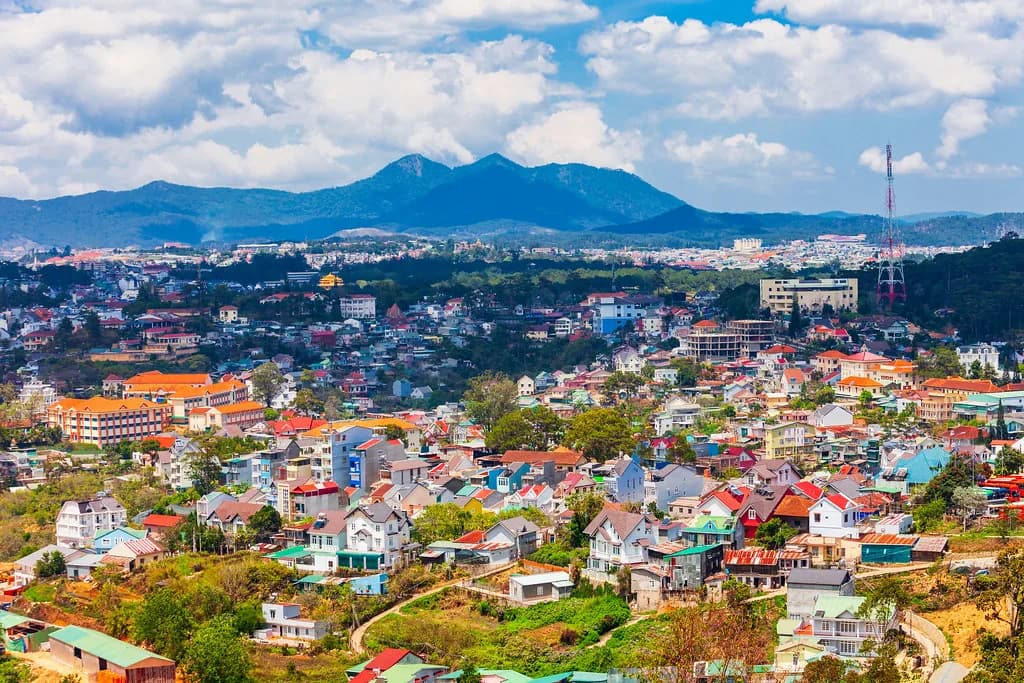
Most Vietnam wardrobes are built for heat and humidity, but Da Lat sits in the Lam Dong highlands, where Vietnam Tourism describes temperate weather and a pine-forest setting as the qualities that made the city a resort centre. Packing here means planning for a cooler highland day rather than a lowland one.
The destination also asks for outdoor and cultural flexibility. Vietnam Tourism points to waterfalls, trekking, mountain biking and camping around the city, and notes that pagoda visitors should dress modestly. A day can move from a sweaty trail to a temple courtyard within a couple of hours.
Layer System for Chilly Mornings and Evenings
Highland mornings and evenings feel noticeably cooler than the middle of the day, so build outfits from movable pieces rather than one heavy garment. A thin base layer sits against the skin, a light mid layer such as a fleece, knit cardigan or sweatshirt adds warmth on demand, and a wind-resistant outer layer handles exposed viewpoints. The aim is to add and remove layers as the day warms and cools.
Choose materials that dry overnight, because a damp cotton sweatshirt will still be wet the next morning in a cool guesthouse room. Merino, polyester blends and light fleece pack small and rinse out in a sink. Vietnam Tourism notes the temperate character of Da Lat's climate rather than extreme cold, so a heavy winter coat is usually more weight than the trip needs.
If you are travelling in a particular month, the layer weight changes more than the item list does. A drier stretch is closer to the suggestions in what to wear in Da Lat in January, while a wetter shoulder-season trip is closer to what to wear in Da Lat in May. Treat those pages as seasonal adjustments to the same three-layer approach.
Small accessories do a lot of work. A light scarf or buff warms the neck on a scooter ride, a compact beanie helps on early starts, and thin gloves are a cheap comfort upgrade if you feel the cold. None are required, but they are the items people most often wish they had packed after the sun drops.
Damp-Weather Protection Without Overpacking
Drizzle and short showers are part of the highland experience, so a compact rain shell is a sensible editorial suggestion rather than a rule. Look for one that folds into its own pocket and fits over your mid layer, so it works as rain protection and as a windbreak at exposed viewpoints. Test the packed size against your day bag before committing to carry it every day.
Rather than packing a full rain suit, pair the shell with quick-dry trousers or shorts and a dry bag or zip pouch for electronics. Vietnam Tourism describes fog mists around Tuyen Lam Lake on many days of the year, a useful reminder that damp conditions can arrive without a dramatic storm.
An umbrella is genuinely useful in a city where much of the walking happens on streets and around the lake, and it doubles as sun cover at midday. A poncho is lighter but flaps on a scooter and offers less control in wind. Pick one and skip the other unless you are travelling with someone who can share the load.
Footwear for Hills, Trails and Wet Ground
Da Lat's appeal is spread across uneven ground: trails in Bidoup Nui Ba National Park, dirt tracks in the pine forests, waterfall paths and sloped city streets. Vietnam Tourism lists trekking, mountain biking and camping among the ways people spend days here, so footwear that handles loose dirt and wet rock matters more than footwear that looks tidy.
Trail runners or light hiking shoes are the most versatile single pair for this terrain. They offer more grip and toe protection than flat sneakers on muddy paths, and they are less bulky than full hiking boots for a trip that also includes city time. The trade-off is that a waterproof membrane keeps water out but also slows drying once water gets in over the top.
A second pair of sandals or slippers earns its place for guesthouses, casual meals and recovery after a wet activity. Canyoning operators working in Da Lat ask guests to bring sports shoes that are allowed to get dirty, plus slippers for afterwards. That is a strong argument for not bringing your only good pair of white trainers.
Break in any new shoes before the trip, and pack a few blister plasters if you are not used to walking on slopes. For monthly footwear decisions, what to wear in Da Lat in June and what to wear in Da Lat in July both sit in the wetter part of the year, when drying time becomes the deciding factor between two pairs.
Modest Outfits for Pagodas and Churches
Da Lat has a dense cluster of religious sites, and Vietnam Tourism singles out Linh Son Pagoda and Truc Lam Temple as hilltop stops worth visiting. The same source advises visitors to dress modestly, which in practice means covering shoulders and knees and keeping beachwear for the lake rather than the temple courtyard.
The practical solution is one outfit that satisfies both a temple visit and a normal day out, so you are not changing clothes between stops. Lightweight trousers or a knee-length skirt, a shirt with sleeves, and a scarf you can drape over your shoulders cover most situations without adding a separate wardrobe. Treat this as an editorial suggestion rather than a formal dress code, since site-specific rules vary and are best checked at the entrance.
Shoes come off at many temple buildings, so socks and slip-on footwear make the visit easier if you would rather not walk barefoot on stone. Domaine de Marie, the colonial-era church and convent, is another site Vietnam Tourism mentions alongside the city's religious architecture, so a modest layer is worth keeping in your day bag even on a casual afternoon.
Outdoor Activity Add-Ons
Canyoning is one of Da Lat's signature wet activities, mixing abseiling, climbing, swimming and sliding through a forested river system. Operator guidance for this activity lists a swimsuit to wear under the wetsuit, easy sports clothing for the morning and afterwards, a sweater for later, a towel, and footwear that can get muddy. Those items are specific to that activity, not a general packing rule for every visitor.
Even without canyoning, a swimsuit and a microfibre towel are worth the space if you plan to kayak or swim, and Vietnam Tourism notes that boats and kayaks are options on Tuyen Lam Lake. A dry bag protects a phone and a small camera on the water. Keep the valuables list short on activity days and leave the rest in your accommodation.
For trekking and mountain biking days, add a small daypack, a refillable water bottle and a light cap. Trail conditions and activity rules are set by the operator or park, so confirm what is provided and what you must bring when you book rather than assuming equipment is included.
What to Leave Behind
Leave the heavy winter coat at home. Da Lat is cool by Vietnamese standards but it is not an alpine destination, and a bulky coat takes up space you will want for layers you can actually wear. A packable mid layer plus a shell covers the same range more flexibly.
Skip the formal evening wardrobe and the dress shoes. Evenings here tend to be casual, and you will get far more use from warm, comfortable pieces than from anything that needs ironing. If a hotel or restaurant has a dress expectation, it will publish that itself, so check with your booking rather than packing defensively.
Cut duplicate toiletries, multiple pairs of jeans and anything you are bringing only for one photograph. Jeans are heavy, slow to dry and unpleasant after a wet walk. If you want a comparison point for building a tighter capsule, the Lyon packing list shows another climate-driven approach to the same exercise.
A Compact 3-Day and 7-Day Packing Example
For a three-day trip, treat clothing as one set worn, one set drying and one spare. In practice that can mean two base layers, one mid layer, one shell, two pairs of quick-dry trousers or shorts, three sets of underwear and socks, one swimsuit, one towel, and one pair of shoes plus sandals. This is an editorial suggestion, not a rule, so adjust downward if you are happy to rinse clothes in the sink.
For a week, add roughly two more base layers, one more pair of trousers and extra socks rather than extra shoes. Socks are the item that keeps a second pair of shoes viable, because dry socks change how a damp shoe feels. Plan one laundry stop mid-trip if you would rather carry less from the start.
Pack the layer system into the top of your bag so you can reach the shell and mid layer without unpacking on arrival, since the temperature difference between your transport and the highlands shows up immediately. A packing cube per category keeps damp-weather items separate from dry clothes.
Weather Check Before Departure
A few days before you fly, read a forecast for Da Lat rather than for Ho Chi Minh City or Hanoi, because highland conditions differ from the lowland cities most itineraries start from. Check the daily high and low, the chance of rain and the wind, then match those numbers to your layers instead of packing for the country as a whole.
Look specifically at the overnight low, since that determines whether your mid layer is a light cardigan or a proper fleece. If rain is forecast across most of your stay, add a second pair of quick-dry trousers and plan for shoes that can handle mud. Forecasts shift, so recheck the day before departure and again on arrival.
Read Da Lat's climate as a historical seasonal pattern rather than a promise about your dates. Vietnam Tourism describes the city's temperate weather as one of its defining features, while conditions on any given week can swing. Use the forecast as the final filter on a list you have already built around layers.
Plan Around Layers, Not Luck
The Da Lat packing list comes down to three decisions: layers you can add and remove, footwear that copes with hills and wet ground, and one modest outfit for temple and church visits. Everything else is a small adjustment based on how long you are staying and what activities you have booked.
Confirm activity-specific requirements with the operator when you book, and check the forecast again in the final days before departure. That combination gives you a list that handles a cool morning, a damp afternoon and a temple stop without carrying a suitcase you will not use.
More packing guides for Vietnam
- What to Wear in Da Lat for a Waterfall Hike
- What to Wear in Da Lat in August: Wet-Season Packing
- What to Wear in Da Lat in January: Packing Guide
- What to Wear in Da Lat in July: A Rainy-Season Layering Guide
- What to Wear in Da Lat in June: Rainy-Season Packing
- What to Wear in Da Lat in May: Layers and Rain Gear
- Da Lat in November: What to Wear for Cool Mornings & Showers
- Ho Chi Minh City Packing List: What to Wear and Pack
- Da Nang Packing List: Heat, Rain, and Beach Essentials
Frequently Asked Questions
What should I pack for Da Lat?
Start with a three-layer system: a thin base layer, a light mid layer such as a fleece or cardigan, and a compact shell that blocks wind and light rain. Add quick-dry trousers, one modest outfit for pagodas and churches, and footwear suitable for hills and wet ground. Then adjust for trip length and any activity you have booked.
What clothes should I wear in Da Lat?
Wear light layers you can add or remove as the day warms and cools, since highland mornings and evenings feel cooler than midday. Quick-dry trousers or shorts work better than heavy denim for outdoor days. For temple visits, choose something that covers shoulders and knees.
Do I need a rain jacket in Da Lat?
A compact rain shell is an editorial suggestion rather than a requirement, but it earns its place because drizzle and fog are common in the highlands. Look for one that packs small, fits over your mid layer and works as a windbreak. An umbrella is a reasonable alternative for city days.
What shoes should I bring to Da Lat?
Trail runners or light hiking shoes are the most versatile option for dirt paths, waterfalls and sloped streets. Add sandals or slippers for guesthouses and for after wet activities. If you book canyoning, operator guidance is to bring sports shoes you do not mind getting dirty plus slippers for afterwards.
What do I wear to pagodas in Da Lat?
Choose modest clothing that covers your shoulders and knees, and keep beachwear for the lake rather than the temple courtyard. A scarf you can drape over your shoulders adds flexibility. Site-specific expectations vary, so check at the entrance rather than assuming a single rule applies everywhere.
Is Da Lat cold at night?
Nights and early mornings are noticeably cooler than the middle of the day, which is why a mid layer and a light scarf matter more here than in Vietnam's lowland cities. The exact overnight temperature changes with the season, so check a Da Lat forecast for your dates rather than packing for an average.
How many days in Da Lat is enough?
Three days covers the city, one waterfall and a lake or temple stop at a comfortable pace. A week lets you add trekking, mountain biking, coffee farm visits and a slower day in the national park. Pack for the longer trip by adding base layers and socks rather than extra shoes.
Sources
Free: The Ultimate Packing Cheat Sheet
A carry-on capsule wardrobe, the complete packing checklist, layering made simple, and what to wear by season — one printable page you'll use on every trip.
You might also like


Continue reading
More guides you'll find useful