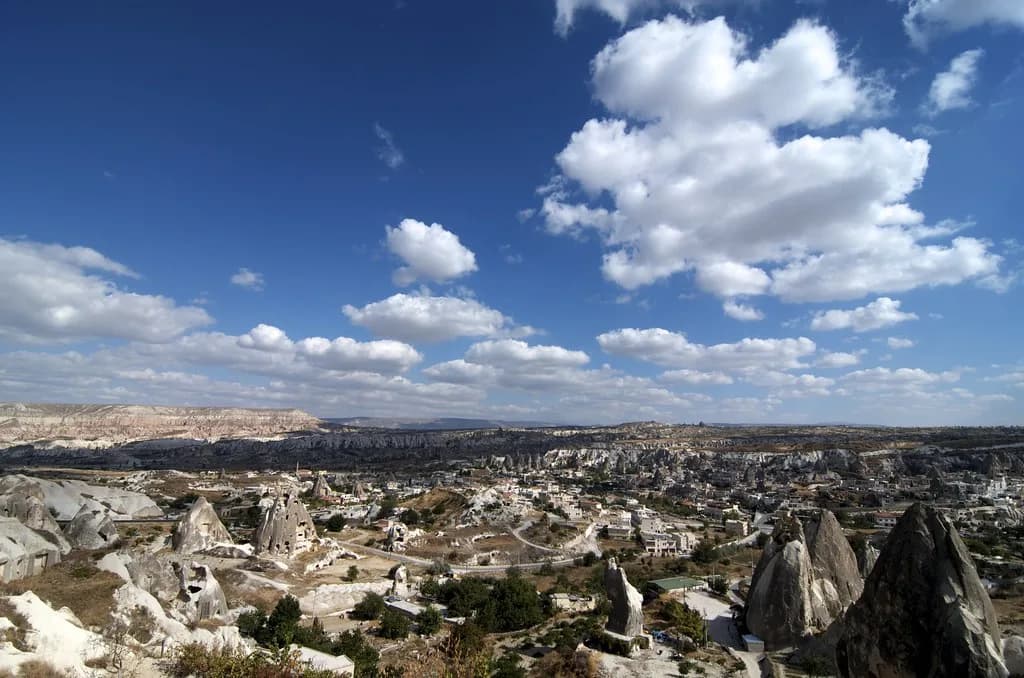
What to Wear in Göreme in July: Hot Days, Cool Caves, Dawn Flights
Plan July outfits for Göreme with breathable layers for hot afternoons, a warm jacket for cool cave rooms and pre-dawn balloon flights, and closed walking shoes.
On this page
Goreme in July: the weather in numbers
Typical July conditions from 30 years of daily weather data, split into early, mid and late month so you can match them to your travel dates.
| Dates | Early Jul (1–10) | Mid Jul (11–20) | Late Jul (21–31) |
|---|---|---|---|
| Afternoon high | 30°C (85°F) | 31°C (87°F) | 32°C (89°F) |
| Night-time low | 15°C (58°F) | 15°C (59°F) | 16°C (60°F) |
| Feels like (afternoon) | 27°C (81°F) | 28°C (82°F) | 29°C (84°F) |
| Range of afternoon highs | 26–34°C | 26–35°C | 27–36°C |
| Days with rain | Rare | 1 in 10 days | Rare |
| Afternoon humidity | 25% | 26% | 24% |
| Average wind | 11 km/h | 11 km/h | 11 km/h |
| Daylight | 14.6 h | 14.4 h | 14.2 h |
What this means for your suitcase
- Hot afternoons: loose, breathable fabrics like linen or cotton, short sleeves and a sun hat.
- Evenings run about 16°C (28°F) cooler than afternoons — carry a layer for after sunset.
- Day-to-day swings: afternoon highs range from about 26°C to 35°C, so pack for both.
Travelling on specific dates? Use our What to Wear Planner for the weather, outfits and a packing list for your exact days in Goreme.
Averages for 1991-2020, modelled from Copernicus ERA5-Land and ERA5 reanalysis via Open-Meteo open data (CC BY 4.0), adjusted to Goreme's elevation. Modelled afternoon highs can read 1–2°C below airport weather-station records.
July in Göreme is usually the hottest stretch of the Cappadocian year, yet the day is not uniformly hot. Historical seasonal tendencies for summer in this part of central Anatolia point to daytime heat with noticeably cool mornings and evenings, which is why a light jacket remains useful even in peak summer. If you are working from a general packing list, the Göreme packing list covers the year-round essentials; this page concentrates only on July decisions.
The practical consequence is that July packing here is a layering problem. You will want breathable fabric for open valleys and midday rock, a warmer layer for cave hotel rooms and pre-dawn starts, and footwear that handles loose volcanic ground. Treat every item below as an editorial suggestion for comfortable travel, not a rule about what anyone must wear.
July Conditions to Plan Around
Summer in Cappadocia is typically hot and dry, with a daily swing that can turn a warm afternoon into a cool evening within about an hour of sunset. That pattern is a historical tendency rather than a forecast, so it tells you what kinds of clothes to bring, not what a specific date will do. One published packing guide describes summer in Cappadocia as reaching roughly 15°C to 35°C (59°F to 95°F) across the day, with cold mornings and evenings despite the daytime heat.
Two other conditions matter more than the headline high. The single most photographed activity, the balloon flight, launches before dawn when the ground is at its coolest, and cave interiors stay at an almost constant temperature regardless of the outdoor heat. Another packing guide notes that pre-dawn balloon temperatures in July can sit around 12°C to 15°C (54°F to 59°F) and that cave hotels hold a steady indoor temperature even in August.
Volcanic tuff underfoot is the third factor. The valleys are soft rock, dust and loose gravel, with unmarked stretches and occasional scrambling, and the stones around the Open Air Museum are uneven. Plan clothing and shoes for that surface rather than for a paved city day.
The Three-Layer Formula for a Göreme July Day
A workable July system is a breathable base, an insulating mid layer, and a light outer layer for sun, wind and dust. The base handles midday heat; the mid layer, ideally something that compresses small, is what makes a pre-dawn balloon flight comfortable rather than endurable; the outer layer covers exposed valley rims and doubles as sun cover. A separate lightweight scarf earns its place because it covers shoulders where you want extra modesty and keeps dust off your face on windy days.
Layers you can add and remove matter more here than one warm coat. Desert-style day-to-night swings reward a system you can adjust on the move, since you may shed a layer in a valley, add it in an underground passage, and need it again after sunset.
What to Wear for Hot Afternoons in the Valleys
For daytime exploring, choose loose tops in cotton, linen or a breathable technical fabric, long sleeves where you want full sun cover, and light trousers or shorts depending on how much sun exposure you can tolerate. On a lighter day such as the Red Tour route, a breathable dress with comfortable walking shoes can work, provided it is not floor-length and you accept the dust. Save the delicate fabrics for dinner, because tuff dust is fine, pervasive and hard to remove.
A wide-brim hat, sunglasses and high-factor sunscreen are the highest-value items in the bag for these hours. Confirm the current UV index and daily heat before you go, since July intensity varies, and reapply sunscreen during a full day outdoors.
Pre-Dawn Balloon Outfit: Trousers and Closed Shoes
A balloon morning is a cold-weather outfit decision, not a summer one. You are typically collected around 4.30am, wait in a field while the envelope inflates, then fly for about an hour in moving air. Wear the insulating layer you packed, long trousers rather than a skirt so you can step into the basket comfortably, and closed shoes with some grip. Tie back long hair, and skip loose scarves near the burners. Flights are frequently cancelled for wind, so build in more than one possible morning if the flight is the point of the trip. If you would rather start from a broader seasonal overview, the Göreme Summer Packing List covers the same months in less detail.
Underground Cities and Cave Interiors
Going underground changes what you need. The green-tour route typically includes an underground city where you spend the morning in tunnels that require you to hunch over in places, and one packing guide advises against dresses for exactly that reason, recommending trousers or shorts instead. You will also get warm on the descent before the cool interior does its work, so dress for both phases. Closed shoes with grip are the right call because floors in these passages are worn smooth and can be slippery, and bulk on your back only makes low, narrow corridors harder to negotiate.
Cave hotel rooms work the same way in reverse. Rock insulates well, which is why a room can feel cool after a hot afternoon even in August. Keep a light layer within reach for sitting still in the evening, and note that many cave hotels involve stone stairs, which is an argument for a soft bag rather than a hard case.
Sandals or Closed Shoes? A Terrain Decision
This is a terrain trade-off, not a style preference. Open sandals and flip-flops are a poor match for loose gravel, dusty slopes, uneven stone at the Open Air Museum and slick underground passages. Closed walking shoes handle all three, and you do not need specialist hiking boots: comfortable athletic shoes are generally enough on the Red Tour, while a grippier pair helps on the more demanding Green Tour ground. Pack one comfortable pair for the evening, two to three pairs total, and expect them to get dusty. For cooler or wetter conditions on another trip, the Göreme Autumn Packing List covers the layers that season demands.
Sun Protection Kit for Exposed Valleys
Sun protection is the part of the list with the least room for compromise. Wide-brim hat, sunglasses, high-factor sunscreen and covered shoulders do more for comfort than any single garment, and you should reapply sunscreen through a day that starts before sunrise and ends after it. Loose, long-sleeved coverage in a breathable fabric cools by shading skin, so it is not a trade-off against heat.
A light scarf rounds out the kit, useful for shoulders, for windblown dust in the valleys, and for warmth at dawn. If you plan to visit any working religious site, cover shoulders, knees and hair and remove shoes at the door, with a scarf covering all of it. Requirements vary by site, so check with the site or your tour operator rather than relying on a general rule.
A Compact Four-Day July Packing Example
For a four-day July trip based in Göreme, start with three breathable tops and one long-sleeved sun layer. Add one insulating mid layer and one light wind or sun shell, two pairs of trousers or shorts plus one pair you could wear in a low-lit passage, and one comfortable evening outfit. Include one scarf, one wide-brim hat, sunglasses, high-factor sunscreen, a refillable bottle, a power bank, and a universal adapter for Turkish sockets. For footwear, pack closed walking shoes plus one pair of sandals for the evening only.
This is enough for a short trip with laundry, and it leaves room for a dust-tolerant spare. If you are comparing shoulder-season conditions for a different trip, the Göreme Spring Packing List covers the layers that season demands.
What to Leave Behind
Leave heels, delicate white garments and anything you would hate to see dusty. Leave floor-length maxi skirts if you plan to enter an underground city, because low passages and steep steps make them awkward. Leave bulky luggage if your cave hotel has stone stairs, and leave business attire you will not touch.
Do not leave the warm layer behind just because it is July. The pre-dawn balloon and cool cave rooms are the two places where a jacket earns its space, and travellers who pack only summer clothing tend to regret it.
Before You Fly: Check the Weather, Then Adjust
Seasonal tendencies are not a forecast. Check a current service for Göreme and the wider Nevşehir area in the days before departure, and note the expected low as well as the high, since the gap between them drives what you actually wear. If the forecast shows a cool dawn, keep the mid layer in your day bag rather than in the suitcase.
Balloon operations are weather-dependent and can be cancelled for wind, so treat any flight as flexible and confirm details with your operator. Also confirm any site-specific dress requirement directly with the site or operator, because those rules are set locally and can change.
Plan Your July Layers
Pack for range, not for one temperature. Breathable day clothes, a genuinely warm mid layer, closed walking shoes, sun cover and a light scarf cover the hot valleys, the cool underground and the pre-dawn flight without overloading a bag. Keep the evening layer accessible rather than buried.
Then verify what is actually checkable: the forecast in the days before you travel, the current dress arrangements at any religious site you plan to visit, and the status of a balloon booking with the operator. Everything else here is a suggestion you can adapt to your own comfort.
Frequently Asked Questions
What should I wear in Göreme in July during the day?
Choose loose, breathable tops and light trousers or shorts, with a wide-brim hat, sunglasses and high-factor sunscreen. Long sleeves in a light fabric shade your skin without trapping heat. Keep a warm layer in your day bag for a cool morning or evening, because July days here are warm but not uniform.
Is it cold in Göreme in the morning in July?
Mornings can feel cool relative to the afternoon, and pre-dawn starts are cooler still. The daily temperature swing in Cappadocia is large enough that a light jacket remains useful even in peak summer. Pack an insulating mid layer and check the expected low, not just the high, before you travel.
What do you wear on a Cappadocia hot air balloon flight in summer?
Wear long trousers so you can step into the basket comfortably, closed shoes with grip, and your warmest layer, because flights launch before dawn when the ground is at its coolest. Tie back long hair and leave loose scarves behind. Confirm arrangements and any weather-related changes with your balloon operator.
Should I wear sandals or closed shoes in Göreme?
Closed walking shoes are the better choice for valleys, the Open Air Museum and underground cities, where the ground is loose, uneven or smooth and steep. Sandals are fine for the evening. You do not need specialist hiking boots for the easier tour routes, but shoes with some grip make the rougher ground noticeably easier.
Do I need a jacket in a cave hotel in July?
A light layer is useful indoors, because rock keeps cave rooms cool even in summer and you feel it when sitting still in the evening. Keep a mid layer accessible in your room. If your cave hotel has stone stairs, a soft bag is easier to manage than a hard case.
What should I leave behind when packing for Göreme in July?
Leave heels, delicate pale fabrics, and anything you would hate to see dusty. Leave floor-length maxi skirts if you plan to enter an underground city, and skip business attire you will not use. Do not leave your warm layer behind, even though July is the hottest month.
Sources
Free: The Ultimate Packing Cheat Sheet
A carry-on capsule wardrobe, the complete packing checklist, layering made simple, and what to wear by season — one printable page you'll use on every trip.
You might also like


Continue reading
More guides you'll find useful